Refill Pouch or Rigid Bottle: Which Trade-Off Matters at Home?
Compare refill pouch or rigid bottle choices by storage, handling, and next use to pick the format that fits your counter, cupboard, and routine.
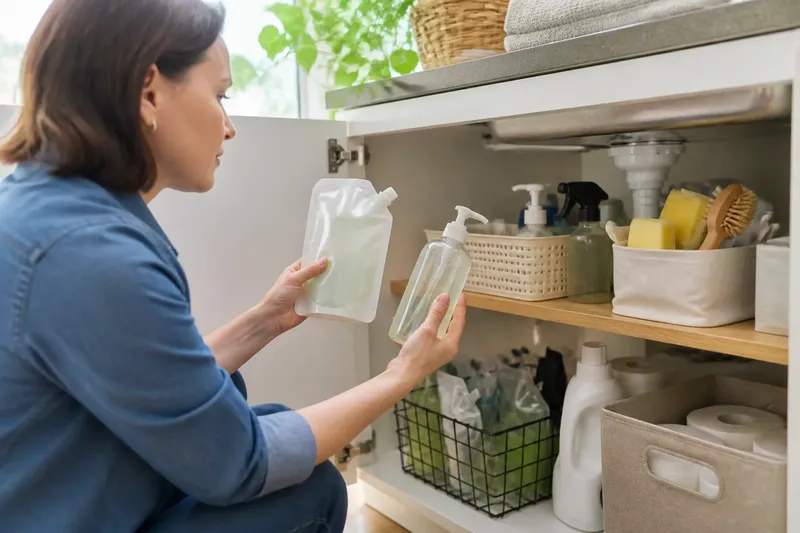
The common mistake with a refill pouch or rigid bottle is choosing by package shape alone: a pouch looks compact, while a bottle looks ready to use. At home, the wrong fit can mean a slippery pour, a container that hogs cupboard space, or an awkward search for somewhere to put the empty package. The better choice depends on how you store, handle, and use the product—and what happens after it runs out.
Neither format is automatically the sensible one. A refill pouch can suit a household with a clean, stable place to transfer product and a bottle already in use. A rigid bottle can be easier when the original container is part of the routine or a refill would create another task. Think through the whole trip from storage to last use, rather than judging the package at the shelf.
What does each format ask you to do?
A rigid bottle is both package and dispensing container. Its shape generally holds itself upright, and its cap, pump, or other closure is already attached. You can usually put it where the product is used, pick it up, and dispense from that same container.
A refill pouch is primarily a supply container. Its flexible sides can make it easier to fit into a crowded drawer, but the pouch may need to be held or supported while pouring. Often, its job is to fill another container, so choosing it also means deciding what will receive the refill and where that container will live.
Those are different jobs, not simply different materials. A bottle keeps the dispensing routine contained in one object. A pouch can separate storage from use, but only if that arrangement works comfortably in your home.
Where will the package live between uses?
Look at the actual storage spot rather than an imagined tidy shelf. A rigid bottle may occupy more fixed space, especially if it needs to stand upright or if its pump makes it tall. Its solid walls, though, make it easy to grasp and less likely to collapse when you move it around a packed cabinet.
A pouch can slip into a narrow gap or lie among other supplies, which may help when cupboard space is irregular. The same flexibility can make it less convenient to locate or retrieve: a soft pouch can slump, fold over, or get buried behind taller items. If it needs to remain upright to avoid leaks or make pouring easier, its apparent space advantage may shrink.
Consider the shelf, drawer, or basket where the product will sit, and how you reach it when your hands are busy. A pouch stored loose in a high cabinet may be less comfortable to handle than one kept in a low bin. A bottle may work better on a counter if its footprint fits without getting in the way.
For shared storage, a stable, easy-to-see home can matter more than compact packaging.
Which one feels easier in your hands?
Handling is part of the product choice, not a minor detail. Bottles offer a firm surface to grip, and many can be used with one hand. But a large or awkwardly shaped bottle can be tiring to hold, and a pump or cap can be inconvenient for someone with limited grip or dexterity.
Pouches are lighter to carry before opening and can be easier to tuck into a shopping bag or storage bin. During a pour, however, the package may flex as its contents shift. A narrow opening can be helpful for directing a stream, while a broad or poorly placed opening can make it harder to control. The precise closure and opening matter; the word “pouch” alone tells you little about how it will pour.
Think about the moment of use: are you holding the container over a sink, working with damp hands, or trying to dispense while the other hand steadies something? A bottle that feels simple in a dry shop aisle may be less convenient at a wet sink. A pouch that stores neatly may need a spare hand to keep it steady.
Choose around the hands and surfaces involved, not just the package’s appearance.
What happens at the next use?
The important question is what you will do with the package after its contents are gone. If you already own a compatible bottle and can refill it without fuss, the pouch may fit a routine you have in place. If no suitable container is available, the pouch can leave you improvising—or prompt you to buy a bottle that takes up space.
A rigid bottle already provides the next-use container, but it may not be intended for repeated refilling. A bottle can be hard to clean thoroughly around a narrow neck or built-in dispenser, and leftover product can make it difficult to tell when it is empty. Before reusing a container, check the product’s directions and the bottle’s condition rather than assuming any package can safely or conveniently serve again.
Imagine you keep hand soap beside a small sink and already have a clean, easy-to-fill dispenser. A pouch that pours neatly into that dispenser may keep the daily setup unchanged, while the pouch itself can go into the storage bin until needed. If the dispenser is difficult to fill or the pouch opening is awkward, the refill adds a chore; a fresh bottle may suit your routine better.
That choice is about the full handoff: purchase, storage, transfer if needed, dispensing, and the empty container. A format that works for only the first part may not feel convenient by the end.
How do storage, handling, and next use compare?
- Storage: A pouch may fit irregular spaces; a rigid bottle is easier to stand and find. Match the package to the place you actually keep it.
- Gripping: A bottle gives a firm surface; a pouch is more flexible. Consider who handles it and whether hands or surfaces are often wet.
- Pouring: A bottle’s dispensing top may be ready for direct use; a pouch may need to transfer contents. Check whether the opening gives you control.
- Routine: A pouch suits a household that already has a practical receiving container. A bottle suits someone who wants the package to dispense directly.
- After use: A refill pouch still needs an end-of-use plan, and a bottle is not automatically reusable. Follow the package directions for handling and disposal.
When directions depend on the product, closure, or local disposal rules, follow the manufacturer’s instructions and local guidance.
Which format fits your routine best?
A pouch may be a better fit if you have a compatible container, a manageable place to store refills, and enough control over the transfer to keep the task comfortable. It can be especially practical when the dispensing bottle is already in a convenient spot and you do not want to replace that setup.
A rigid bottle may suit you if you need a ready-to-use package, share the product with people who prefer a stable grip, or do not want to add a filling task. It can also make sense when the product is used away from a fixed home dispenser and must be picked up and carried during use.
Neither answer has to apply to every product in your home. You may prefer a refill pouch for one item and a rigid bottle for another because their storage spots, openings, or users differ. The main search phrase, refill pouch or rigid bottle, is best answered one product and one routine at a time.
What questions help settle the choice?
Is a refill pouch always easier to store?
Not necessarily. It can fit a narrow or uneven space, but a pouch that needs to stay upright or is hard to spot may be less convenient than a bottle on an accessible shelf.
Can I pour any pouch into an old bottle?
Do not assume every product or container is suitable for refilling. Check the package directions and the receiving container’s condition, opening, and compatibility before transferring anything.
Is a rigid bottle easier for everyone to use?
Its firm shape can make it easier to grip and set down, but a bulky bottle, tight cap, or stiff pump may create its own difficulty. Consider the specific closure and the person who will use it.
What if I have no refill container?
Compare the pouch’s filling demands with the effort of finding and maintaining a suitable container. If transferring product would become an irritating extra chore, a dispensing bottle may be the more workable choice.
What is the simplest way to decide?
Before buying, identify where the package will be stored, how it will be held during use, and what will happen when it is empty. If you are considering a pouch, name the receiving container and make sure you have a realistic place to pour and store it. If you are considering a bottle, check that its shape and closure suit the spot and the people using it.
Then choose the format that removes friction from the part of the routine you repeat most. A pouch is not a better choice just because it looks compact, and a bottle is not a better choice just because it is ready to dispense. The useful decision is the one that leaves you with an accessible product, a manageable next use, and no awkward package to deal with in the middle of an ordinary day.